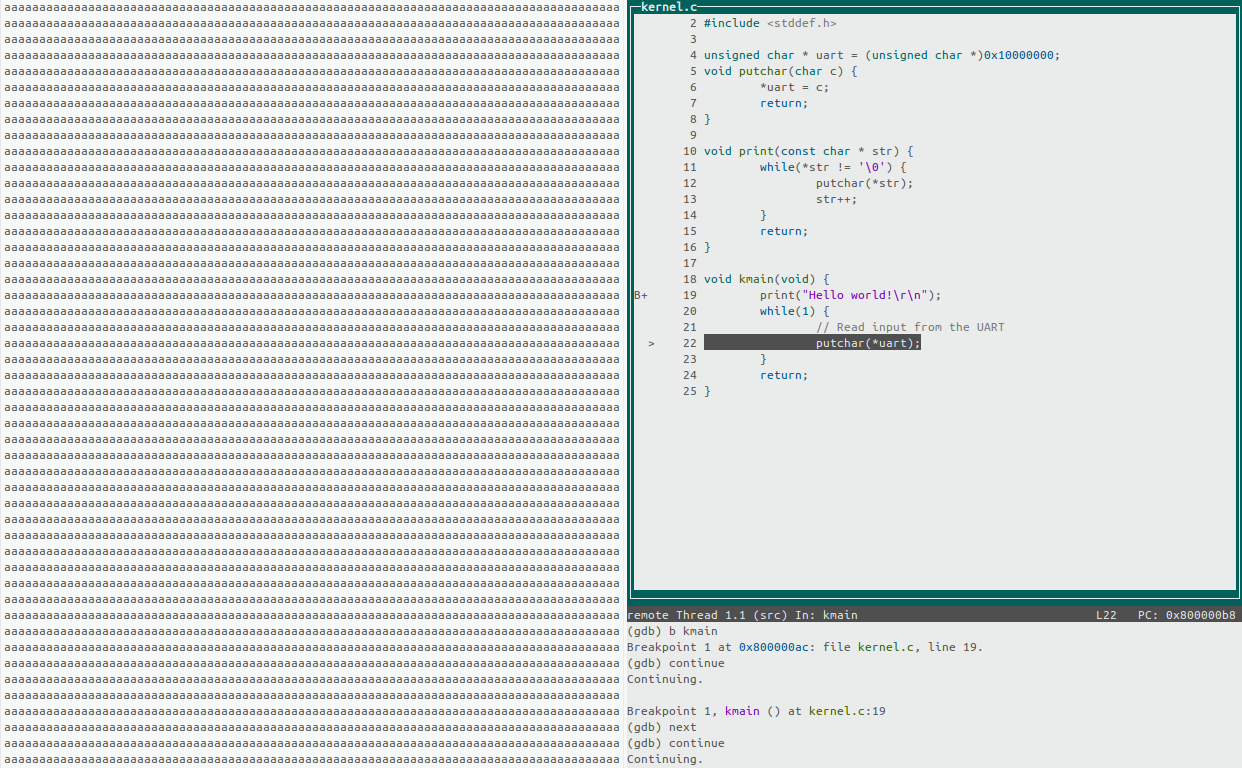
continuation of "qemu-riscv-virt"
Goals:
- Debug a bare bones application running on qemu, using gdb
- Gain insight on RISCV boot (ZSBL: Zero stage boot loader)
Required files and dependencies:
- kernel.c
- entry.S
- linker.ld
- ubuntu-24-04
- riscv-gnu-toolchain ( nightly release from risc-collab repo )
- qemu (qemu-system-misc, includes rv64 and rv32)
Instructions
- compile keeping debug info and disabling optimizations
$ riscv64-elf-gcc -g -O0 -Wall -Wextra -c -mcmodel=medany kernel.c -o kernel.o -ffreestanding
$ riscv64-elf-as -c entry.S -o entry.o
$ riscv64-elf-ld -T linker.ld -lgcc -nostdlib kernel.o entry.o -o kernel.elf --static -L riscv64-elf/riscv/lib/gcc/riscv64-unknown-elf/16.1.0/- run qemu, wait for gdb
$ qemu-system-riscv64 -machine virt -bios none -kernel kernel.elf -serial mon:stdio -nographic -S -gdb tcp::1234- run gdb, connect to qemu
$ alias riscv64-elf-gdb="./riscv64-elf/riscv/bin/riscv64-unknown-elf-gdb"
$ riscv64-elf-gdb kernel.elf
(gdb) target remote tcp::1234- list functions
(gdb) info functions
  All defined functions:

  File kernel.c:
  18:     void kmain(void);
  10:     void print(const char *);
  5:      void putchar(char);

  Non-debugging symbols:
  0x0000000080000000  start
0x0000000080000024 bss_clear- check our starting instruction
(gdb) x/i $pc
  => 0x1000:      auipc   t0,0x0
    //program counter is at 0x1000
    //so were not at "start:" (0x80000000) yet.
//lets see how we get there first- check all instructions until we jump to "start:"
(gdb) disassemble $pc, $pc+0x17
Dump of assembler code from 0x1000 to 0x1017:
=> 0x0000000000001000:  auipc   t0,0x0
   0x0000000000001004:  addi    a2,t0,40 # 0x1028
   0x0000000000001008:  csrr    a0,mhartid
   0x000000000000100c:  ld      a1,32(t0)
   0x0000000000001010:  ld      t0,24(t0)
0x0000000000001014: jr t0- how were this instructions generated?
// in qemu's virt, the code before hitting "start:" corresponds to the VIRT_MROM region.
// it is populated by qemu's riscv_setup_rom_reset_vec()
// here we can see how it's generated

// RISC-V bootup process first step is to run the ZSBL (Zero Stage Bootloader).
// the ZSBL inializes some registers and then jumps to other address
// for this case, that would be our elf's "start:"

//from https://github.com/qemu/qemu/blob/master/hw/riscv/boot.c

void riscv_setup_rom_reset_vec(
    MachineState *machine,
    RISCVHartArrayState *harts,
    hwaddr start_addr,
    hwaddr rom_base, hwaddr rom_size,
    uint64_t kernel_entry,
    uint64_t fdt_load_addr)
{
    const bool rv32 = riscv_is_32bit(harts);
    const bool big_endian = harts->harts[0].cfg.big_endian;
    uint32_t reset_vec[CODE_WORDS + DATA_WORDS];

    /* .text (RISC-V instructions are always little-endian) */
    reset_vec[0] = const_le32(0x00000297);      /* 1:  auipc  t0, %pcrel_hi(fw_dyn) */
    reset_vec[1] = const_le32(0x02828613);      /*     addi   a2, t0, %pcrel_lo(1b) */
    reset_vec[2] = const_le32(0xf1402573);      /*     csrr   a0, mhartid  */
    if (harts->harts[0].cfg.ext_zicsr) {
        reset_vec[2] = const_le32(0xf1402573);  /*     csrr   a0, mhartid  */
    } else {
        /*
         * The Zicsr extension has been disabled, so let's ensure we don't
         * run the CSR instruction. Let's fill the address with a non
         * compressed nop.
         */
        reset_vec[2] = const_le32(0x00000013);  /*     addi   x0, x0, 0 */
    }
    if (rv32) {
        reset_vec[3] = const_le32(0x0202a583);  /*     lw     a1, 32(t0) */
        reset_vec[4] = const_le32(0x0182a283);  /*     lw     t0, 24(t0) */
    } else {
        reset_vec[3] = const_le32(0x0202b583);  /*     ld     a1, 32(t0) */
        reset_vec[4] = const_le32(0x0182b283);  /*     ld     t0, 24(t0) */
    }
    reset_vec[5] = const_le32(0x00028067);      /*     jr     t0 */

    /* .data (must match the firmware's data endianness) */
    if (big_endian) {
        stq_be_p(&reset_vec[6], start_addr);    /* start:       .dword */
        stq_be_p(&reset_vec[8], fdt_load_addr); /* fdt_laddr:   .dword */
    } else {
        stq_le_p(&reset_vec[6], start_addr);
        stq_le_p(&reset_vec[8], fdt_load_addr);
    }

    rom_add_blob_fixed_as("mrom.reset", reset_vec, sizeof(reset_vec),
                          rom_base, &address_space_memory);
    riscv_rom_copy_firmware_info(machine, harts,
                                 rom_base, rom_size,
                                 sizeof(reset_vec),
                                 kernel_entry);
} - so, lets comment our ZSBL, using what we just learned from riscv_setup_rom_reset_vec()
(gdb) disassemble $pc, $pc+0x17
Dump of assembler code from 0x1000 to 0x1017:
=> 0x0000000000001000:  auipc   t0,0x0
    //saves current $pc to $t0
    //$t0 = $pc+{0x0,12'd0}
  0x0000000000001004:  addi    a2,t0,40 # 0x1028
    //pointer to fw_dynamic_info struct . unused, for linux boot only
    // (QEMU's default boot mechanism, from OpenSBI)
    //$a2 = $t0+{40+2**12}
  0x0000000000001008:  csrr    a0,mhartid
    //(HART ID) hardware thead id. unused, for linux boot only
    //$a0 = hardware_thread_id from ctrl_and_status_register
  0x000000000000100c:  ld      a1,32(t0)
    //fdt (flattened device tree), unused, for linux boot only
    //$a1 = *(32+0x1000) // 0x87e00000
  0x0000000000001010:  ld      t0,24(t0)
    //$t0 = *(24+0x1000) // 0x80000000
  0x0000000000001014:  jr      t0
//jumps directly to "start:" at 0x80000000- Check fw_dynamic_info struct generation
//from https://github.com/qemu/qemu/blob/master/hw/riscv/boot.c

void riscv_rom_copy_firmware_info(MachineState *machine,
                                  RISCVHartArrayState *harts,
                                  hwaddr rom_base, hwaddr rom_size,
                                  uint32_t reset_vec_size,
                                  uint64_t kernel_entry)
{
    struct fw_dynamic_info32 dinfo32;
    struct fw_dynamic_info64 dinfo64;
    void *dinfo_ptr = NULL;
    size_t dinfo_len;
    const bool rv32 = riscv_is_32bit(harts);
    const bool be = harts->harts[0].cfg.big_endian;

    if (rv32) {
        dinfo32.magic = be ? cpu_to_be32(FW_DYNAMIC_INFO_MAGIC_VALUE)
                           : cpu_to_le32(FW_DYNAMIC_INFO_MAGIC_VALUE);
        dinfo32.version = be ? cpu_to_be32(FW_DYNAMIC_INFO_VERSION)
                             : cpu_to_le32(FW_DYNAMIC_INFO_VERSION);
        dinfo32.next_mode = be ? cpu_to_be32(FW_DYNAMIC_INFO_NEXT_MODE_S)
                               : cpu_to_le32(FW_DYNAMIC_INFO_NEXT_MODE_S);
        dinfo32.next_addr = be ? cpu_to_be32(kernel_entry)
                               : cpu_to_le32(kernel_entry);
        dinfo32.options = 0;
        dinfo32.boot_hart = 0;
        dinfo_ptr = &dinfo32;
        dinfo_len = sizeof(dinfo32);
    } else {
        dinfo64.magic = be ? cpu_to_be64(FW_DYNAMIC_INFO_MAGIC_VALUE)
                           : cpu_to_le64(FW_DYNAMIC_INFO_MAGIC_VALUE);
        dinfo64.version = be ? cpu_to_be64(FW_DYNAMIC_INFO_VERSION)
                             : cpu_to_le64(FW_DYNAMIC_INFO_VERSION);
        dinfo64.next_mode = be ? cpu_to_be64(FW_DYNAMIC_INFO_NEXT_MODE_S)
                               : cpu_to_le64(FW_DYNAMIC_INFO_NEXT_MODE_S);
        dinfo64.next_addr = be ? cpu_to_be64(kernel_entry)
                               : cpu_to_le64(kernel_entry);
        dinfo64.options = 0;
        dinfo64.boot_hart = 0;
        dinfo_ptr = &dinfo64;
        dinfo_len = sizeof(dinfo64);
    }

    /**
     * copy the dynamic firmware info. This information is specific to
     * OpenSBI but doesn't break any other firmware as long as they don't
     * expect any certain value in "a2" register.
     */
    if (dinfo_len > (rom_size - reset_vec_size)) {
        error_report("not enough space to store dynamic firmware info");
        exit(1);
    }

    rom_add_blob_fixed_as("mrom.finfo",
                           dinfo_ptr,
                           dinfo_len,
                           rom_base + reset_vec_size,
                           &address_space_memory);
}- Compare values in memory with the struct fields
(gdb) x/6xg 0x1028
  // x: examine memory
  // /
  // 6: 6 times
  // x: as hex
  // g: giant (8 bytes, rv64 word size)
  // 0x1028: starting address
0x1028: 0x000000004942534f      0x0000000000000002
0x1038: 0x0000000080000000      0x0000000000000001
0x1048: 0x0000000000000000      0x0000000000000000

struct fw_dynamic_info {
   unsigned long magic;     // 'OSBI', 0x4942534f
   unsigned long version;   // Info version. The current latest is 0x2
   unsigned long next_addr; // Next booting stage address, 0x80000000
   unsigned long next_mode; // Next booting mode.FW_DYNAMIC_INFO_NEXT_MODE_S=1
   unsigned long options;   // OpenSBI options
   unsigned long boot_hart; // Preferred boot HART id
} - TUI debugging on gdb
now that we understand how we get to "start:", lets step through our elf using TUI
(gdb) tui enable
(gdb) b kmain
    //set breakpoint at kmain()
(gdb) continue
    Continuing.
Breakpoint 1, kmain () at kernel.c:19
    //gdb breaks at kmain, before our print()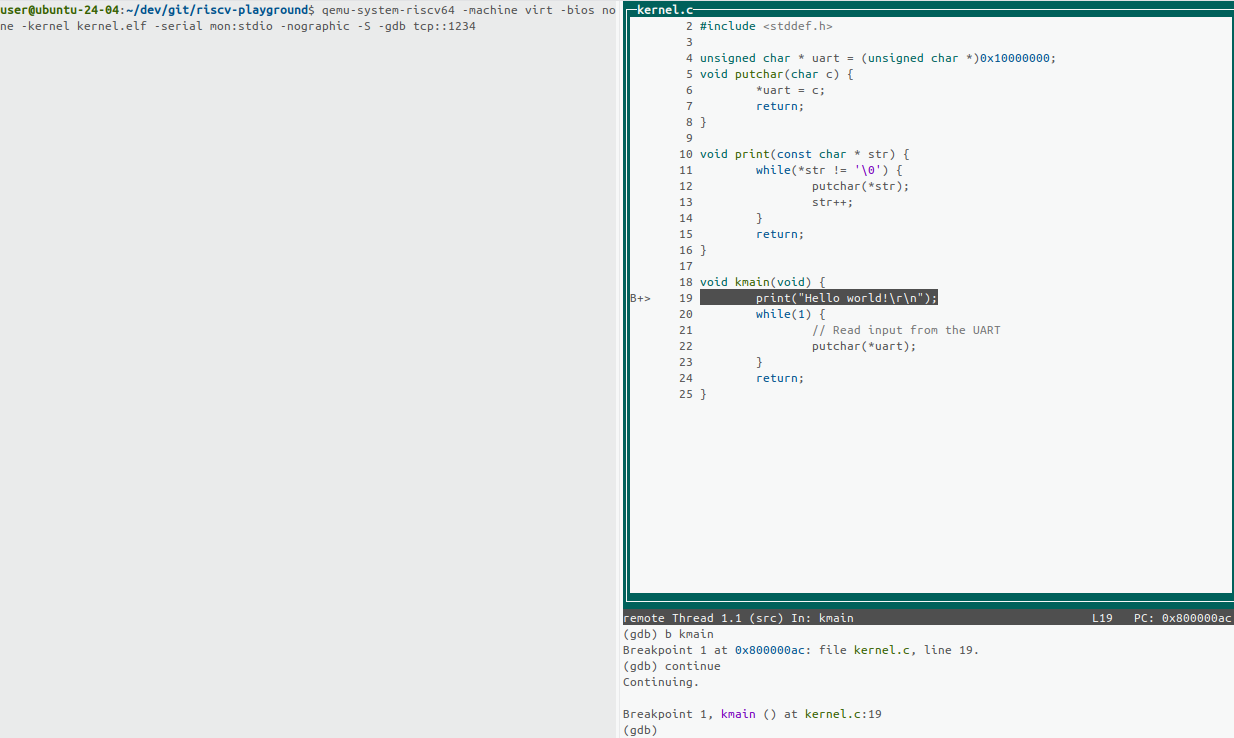
- run next line
(gdb) next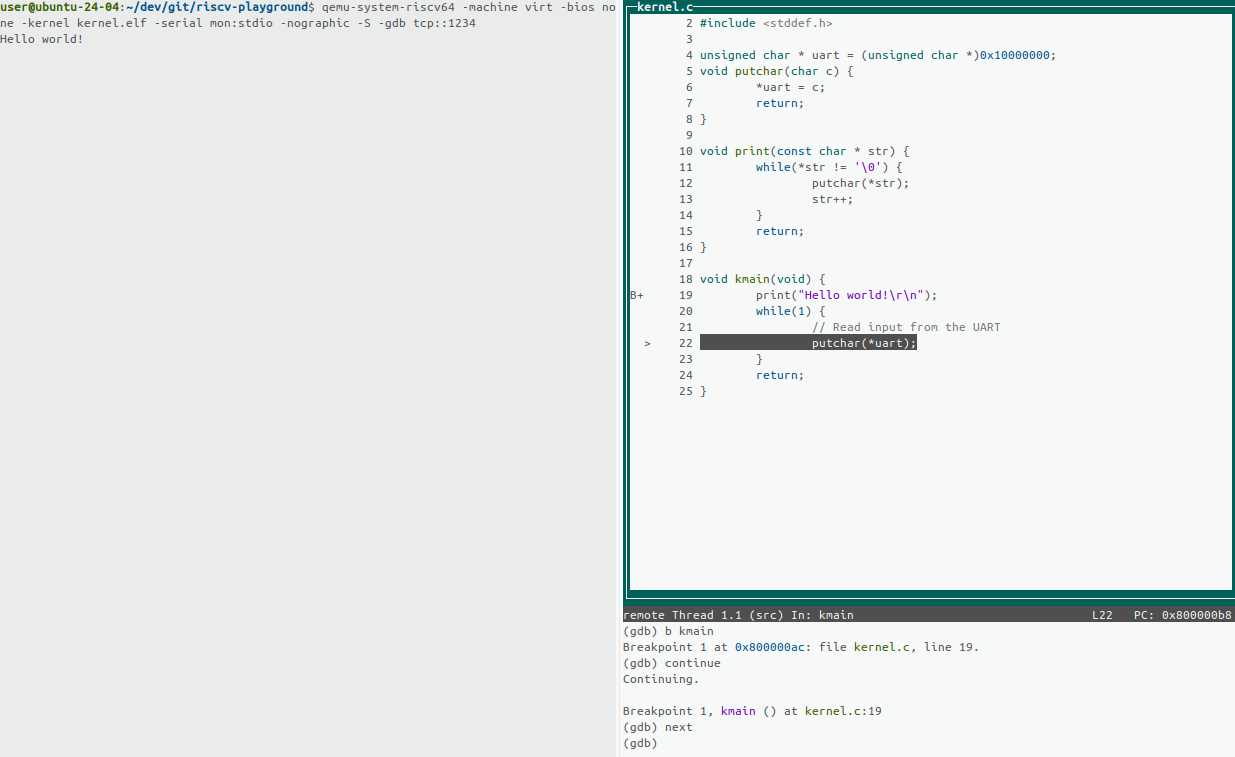
- continue to inf loop
(gdb) continue
    Continuing.
// kmain will print any key input on qemu's terminal

// press Ctrl+A then X to terminate QEMU
// type "exit" to quit gdb